
Failure to Reeducate: Perpetuations of Cultural Fascism in Post-War Germany
World War II is commemorated as the defeat of fascism in Europe, but Germany retained a profound culture of fascism through the post-war era, which lingers to this day. Despite a Nazi cleanse in the initial stage of Allied occupation and a brief era of left-wing hegemony across Europe (Saull 17), the release of former fascists into society and the rebranding of fascist politics as capitalist populism crushed the possibility of a long-term democratic order and allowed German culture—expressed through politics, film, and publications—to remain steeped in the authoritarian, ethnocentric prejudices of fascism. However, the reeducation process in Germany, led by the United States, was brief and largely performative, aiming to promote capitalism and a performative image of anti-fascism rather than democracy itself (Saull 16); cultural productions in Germany remain fascist to this day.
Heavily influenced by American fears of expanding Soviet influence at the start of the Cold War, the new Federal Republic of Germany (West Germany) was built on old Nazi frameworks (Saull 19), with communists and leftists—leaders of anti-fascist resistance movements during the war—facing greater scrutiny and limitations than former members of the Nazi party (15). In the 21st century, a conservative hegemony and rising fascism in the West—led by the US—has drawn concern and attention from contemporary theorists and public intellectuals. Analyzing the failure to eliminate fascism from German culture provides a possible answer for how to eliminate fascism from modern Western culture, if those who control systems of education and cultural industry so choose.
Organized in 1924 around intellectuals Theodor Adorno, Max Horkheimer, and Herbert Marcuse, among others, the Frankfurt School sought to condemn the political and cultural destructiveness of fascism, which they defined as an antidemocratic “syndrome” expressed through ethnocentric prejudice (Adorno et al. 1; Levinson “Study of Ethnocentric Ideology” 114). They developed a pedagogical framework for nonsocialist Western states to transition to socialism, which they saw as the only viable solution to the societal ills of capitalism (Gottfried 59). When Hitler was appointed chancellor in 1933, the Frankfurt School dissolved and its members, many Jewish, went into exile; eventually, the group regrouped in New York as the Institute for Social Research at Columbia University, and several members worked as advisors to the Office of Strategic Services, a precursor to the CIA (61). After identifying that “fascism had just been defeated in war” (Adorno et al. 1), they advised that Nazism and its antisemitic prejudice could be expunged from West German society before causing any more harm through a process of reeducation, which led to a brief period of intense denazification by Allied occupiers. Fascist and nationalist teaching materials were censored in schools, and public lectures were given on Germany’s brutality during the war (Gottfried 68).
In conjunction with their reeducation program, Allied occupation forces began their administration of Germany by purging 53,000 state functionaries with ties to the Nazi Party (Nationalsozialistische Deutsche Arbeiterpartei) from their governmental roles (Saull 20). For a brief moment, Western Europe appeared to have achieved left-leaning hegemony, poised to embrace radical democracy (17). But, by the end of 1945, Allied authorities in West Germany, led by the US, banned the leftist, anti-fascist resistance movement that had operated within Germany throughout World War II (19), fearing Soviet influence from Soviet-aligned communists and anti-Stalinist leftists alike (18). Allied forces established a capitalist system in West Germany, enacting the economic intervention outlined in the Marshall Plan, bolstering the established upper class, and promoting far-right politicians who voiced support for capitalism (17-9). The denazification process was officially terminated in 1947 (Solty 44) and, by the next year, 52,000 purged Nazis were back in government, with many holding powerful positions (Saull 20). Comparatively, under Soviet occupation, the German Democratic Republic (East Germany) was primarily led by former resistance leaders, survivors of concentration camps, and returned political and intellectual exiles (Solty 56). Allied occupiers and West German elites performed liberalism by continuing to vocally celebrate the defeat of fascism while simultaneously allowing the reinstatement of fascist rule (81). The Frankfurt School’s theory of reeducation went untested, as the denazification period ended before yielding antifascist results in West German government or culture.
The US official tasked with eliminating Nazism in Bavaria, William Griffith, complained that he was unable to fulfill his directive because, thanks to the decisions of his superiors, “Nazis, militarists, industrialists and bureaucrats were free to re-enter society. … the flood of ‘renazification’ ran full tide” (Saull, 20). Confirming this assessment, in 2016, the Federal Ministry of Justice and Consumer Protection (Bundesministerium der Justiz und für Verbraucherschutz) reported that, of the 170 lawyers born before 1927 who held senior positions in the Ministry from 1949 to 1973, 90 were former members of the Nazi party (30). Thirty-four were also members of the Sturmabteilung (SA or “Brownshirts”), the paramilitary wing of the early Nazi Party, and six belonged to the Schutzstaffel (SS), the organization that primarily carried out the Holocaust (30). These individuals, placed in positions of power by the supposedly democratic Allied states, had been seduced by the fascist politics of Nazism, and those who further applied for SA or SS membership saw something attractive in the persecution and genocide that made these organizations infamous. In his analysis of this renazification, Griffith asserted that many of these officials were “present-day authoritarians” who used their positions to perpetuate the antidemocratic policies of fascism (20). These men did not want to see fascism eliminated from German culture, and, as long as fascism could be rebranded as populist conservatism, neither did capitalist Allied occupiers.
As early as 1944, when the American Jewish Committee and Max Horkheimer began working on what later became Studies in Prejudice, Germany and the United States had been identified as the two equally concerning hotbeds of fascism that most required attention from critical theorists, as summarized by philosopher and historian Paul Gottfried (69). In Dialectic of Enlightenment, Horkheimer and Adorno blamed capitalist “culture industry,” which filters reality into ideology through passively-consumed media (99-100), for luring Americans into the belief that their needs were met—despite the obvious social and economic inequalities in the post-war era (Gottfried 62). Further, they pointed out that in “[p]refascist Europe … [t]he German educational system, including the universities, the artistically influential theatres, the great orchestras, and the museums were under patronage,” which allowed them “a degree of independence from the power of the market” that was lost with the rise of capitalism (Horkheimer and Adorno 105). This implies that the post-war adoption of capitalism in West Germany was desired by the US because it would create an unfree culture industry that produced nothing but capitalist, fascist propaganda. Adorno et al. published “The Authoritarian Personality” in Studies in Prejudice as a further critique, warning that the US was susceptible to populist demagogues, just as Germany had been during the interwar period, and specifically calling out “New Deal liberalism” for promoting “slight change” rather than anticapitalist and, by extension, antifascist radical change in the US (Levinson “Politico-Economic Ideology” 157). Frankfurt School theorists developed the idea that fascism was a mistake made in the transition from capitalism to socialism (Gottfried 62), and they posited that the only remedy for the US, which was observably sliding toward fascism, was to commit to a system of reeducation similar to the one aborted in West Germany (66) and, according to Horkheimer and Adorno, engage culture in setting the state on a socialist course (59).
During the initial denazification period, authorities of the Allied occupation zones, particularly the American and British, issued lengthy questionnaires (Fragebogen) among the German populace to flag Nazis, Nazi collaborators, and individuals who presented as sympathetic to fascist thought (67-8). Individuals who were explicitly connected to the Nazi party or suspected of holding anticommunist or nationalist beliefs were dismissed from the West German film industry and denied newspaper and book publishing licenses (Solty 44; Gottfried 68). After the renazification of the West German government, these restrictions were dropped, and fascism exploded in film and print.
Directors, producers, and some actors who rose to fame producing propaganda films for Hitler’s Third Reich immediately returned to prominence. According to German political writer Ingar Solty, “it was only in exceptional cases that leading Nazi directors did not continue their careers in West Germany” (44). In rare cases, filmmakers like Veit Harlan—who held the record as the director of the most films banned by the Allied Control Council—and Carl Froelich—who headed Nazi Germany’s Association of Film Production and Distribution and was president of the National Film Board during WWII—were briefly expelled from the West German film industry for their reputations as the worst fascist propagandists (46, 48). After 1948, however, these men were reclassified as “denazified” and allowed to return to the industry (46). Gerhard Menzel, one of 87 writers who signed the Pledge of the Most Faithful Followers (Gelöbnis treuester Gefolgschaft) to Hitler, turned to Heimatfilme, pastoral celebrations of rural German culture and morals (48), and Wolfgang Liebeneiner, who formerly produced Operation T-4 pro-euthanasia films for the Nazi Ministry of Propaganda, used science fiction films with heavy metaphors to promote the narrative of Austria’s victimhood after the war (45). Rather than eliminating fascist propaganda from West German cinema, Allied occupiers allowed many more of these nationalist, revisionist films to be made. Well-known filmmakers, including those mentioned above, were not simply swept up in the Nazi wave of cultural fascism like many other German citizens; they were the producers of this culture. The fascist undertones of their work during the post-war era—subtle only compared to their earlier work as Nazis—indicate that these filmmakers truly wanted to promote a fascist culture, and their prolific success in cinema shows that fascist cultural productions remained in demand.
The first scholar to research Nazism in West German film, Hans-Peter Kochenrath, wrote in 1975 that “one can speak without exaggeration of an uninterrupted continuation of the Third Reich film in West Germany” (48). The frequently-echoed excuse for this perpetuation of cultural fascism, popularized by sociologist Peter Pleyer in 1965, is that eliminating Nazis from film was impossible because “almost all directors, writers, actors, cameramen and technicians had been more or less active members of the Nazi Party. That is why over the course of time this policy changed and now licenses were issued to film-makers including those who had only passively formally belonged to the Party” (57). Solty calls this claim “outrageous” (57). He argues that, similar to the renazification of the German government, the success of former Nazi filmmakers in the post-war era was orchestrated and condoned by Allied occupiers as a Cold War tactic to combat Soviet influence—or leftist influence in general—for the benefit of the new capitalist system. Anti-fascist films produced by the Deutsche Film Aktiengesellschaft (DEFA, East German Film Company) were zealously suppressed in West Germany (58), and, after reunification in 1990, 41 DEFA filmmakers were fired as part of a cleansing of socialist creatives from sources of German cultural production (52). From 1948 through 1990 and beyond, the film industry remained solidly under Western control, favouring fascists.
This is not a popular claim. From 1958, a New Left movement emerged in Germany that sought to distance the modern state from its colonial, imperial, and Nazi past (Gerhardt 2). This movement, sometimes called “Fight-nuclear-death” (“Kampfdem-Atomtod”) because of its Cold War context or “68” after the year celebrated as the true end of Nazism in Germany, gained particular success in the film industry (Solty 64; Gerhardt 2). In 1962, 26 directors gathered to sign the Oberhausen Manifesto, which declared, “The old film is dead. We believe in the new film” (“Der alte Film ist tot. Wir glauben an den Neuen”) and demanded new schools and funding to remake the West German film industry, which they viewed as corrupt (Gerhardt 3-4). They sought to replace the fascist culture of West Germany with a distinctly modern “new critical public” (Solty 64).
Three film studies universities opened in the next five years (Gerhardt 4), and films that shed light on the brutalities of the war, which were glossed over in nationalist films by former Nazis, became popular as forces for cultural restoration (Solty 64). Inspired by the French nouvelle vague, revolutionary filmmaker Jean-Luc Godard, philosopher Walter Benjamin, and the culture industry critique of the Frankfurt School (65), Young German Cinema/New German Cinema (YGC is specifically associated with the late 1960s while NGC refers to the broader 1962-1982 artistic period) directors like Werner Herzog, Margarethe von Trotta, and Wim Wenders challenged the fascist aesthetic and messaging of films by former Nazis with experimental, politically leftist, and proudly independent films (Gerhardt 2-3; Solty 65). As these works grew in popularity and came to define German post-war cinema, the Oberhausen Manifesto’s claim that “Daddy’s cinema is dead!” seemed true (65). The New Left used this first victory as motivation to expunge fascist influences from other forms of culture, including music and literature (65, 68). But soldier songs, notably the fascist Schlager, continued to define and influence German folk music (66), and books like the SOS series, established by the War Library to romanticize the experiences of Nazi soldiers and encourage nostalgia for the war, can still be found in almost any West German bookstore (51).
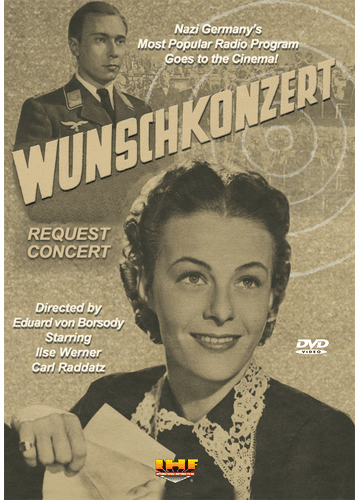
According to historian Dagmar Herzog, “[t]he immediate aftermath of 1968 was saturated by a profound sense of loss,” as New Leftists realized that fascism was not dead. The New Left movement splintered into Marxist-Leninist, Maoist, and other factions, allowing conservatism to regain dominance (221), and fascist culture revived as the public tired of grim leftist art that forced them to face their pasts. When the Allied ban on Nazi films was lifted in 1980, the second-most commercially successful film of the Nazi era, Wunschkonzert (Request Concert), was rereleased in West Germany (Solty 44-5). The nostalgia and acclaim for this war-romance propaganda film, made by Eduard von Borsody in direct cooperation with Joseph Gobbel and declared “state-politically valuable” (“staatspolitisch wertvoll”) by the Nazi Film Evaluation Office for its seductive portrayal of Nazism (44-5), revealed a culture still smitten with fascism beneath the surface-level success of the New Left movement.
Like the bans placed on former Nazis and suspected Nazi sympathizers in the film industry, the exclusion of fascists from the publishing industry ended in 1948, and, within a few years, fascist propaganda was back in print. Established immediately after the war, the conservative Springer group quickly rose to dominate between 28 and 30 percent of the press market in West Germany (Humphreys 80-1). Founded in 1952, Springer’s Bild-Zeitung was the only tabloid with national circulation, and it became the best-selling daily newspaper in Germany by reunification, accounting for 79 percent of national mass-market newspaper sales in 1991 (81). Despite its tagline of “independent, nonpartisan” (unabhängig, überparteilich), the tabloid (commonly shortened to Bild) has always had a reputation for having, as described by Peter J. Humphreys, Fellow of the European Institute of the Media, “a strong Right wing populist orientation” (81). Unsurprisingly, Bild found itself at odds with the rising New Left movement. In 1972, Heinrich Böll, one of Germany’s leading post-war authors who won the Nobel Prize for Literature in the same year, accused the paper of being “no longer crypto-fascist, no longer fascistoid, this is naked fascism. Incitement, lies, filth” (nicht mehr kryptofaschistisch, nicht mehr faschistoid, das ist nackter Faschismus. Verhetzung, Lüge, Dreck) (2). Böll’s condemnation of Bild was in response to an article published in the tabloid two weeks earlier, which reported that six members of the far-left paramilitary organization Red Army Faction (colloquially called Baader-Meinhof) had committed a bank robbery and killed a police officer in a shootout (2). Böll’s issue with this article was that this information, presented as factual, was mere speculation intended to slander Baader-Meinhof and the broader leftist movement. He sarcastically wrote, “Where the police authorities investigate … Bild is already much further ahead: Bild knows” (“Wo die Polizeibehörden ermitteln … ist Bild schon bedeutend weiter: Bild weiß”), and he accused Bild of attempting to incite “mob justice” (“Lynchjustiz”) among its millions of readers through its melodramatic reporting (2). In a society that was fully fascist just 30 years earlier and retained fascist influence in government, film, and print, Böll understood the dangerous impact that fearmongering could have when disseminated by the most popular news publication in West Germany.
Despite Böll’s reputation in leftist and literary circles, his condemnation of Bild did not sway the general German public to abandon the tabloid, and Bild initiated a smear campaign against the author that escalated to a search of Böll’s home after the 1977 kidnapping and murder of former SS officer Hanns Martin Schleyer (1). Bild continued to dominate the news industry in Germany through reunification, with a circulation of nearly 4.3 million copies in 1993 (Humphreys 82). The second best-selling paper and Bild’s primary liberal competitor, Die Zeit, had a readership of just 500,000 (Fazit; Humphreys 82). Nearly eight times as many Germans chose to get their news from a conservative source accused of fascist leanings rather than its liberal counterpart, an indication of the continued fascist leanings of German culture even after 1968. By 2024, Bild’s readership dropped to just under one million print copies daily, but, thanks to its online popularity, today it remains the most popular news source in Germany and one of the most popular in Europe (Fazit), despite being the most frequent violator of the German Press Code and continuing to draw harsh criticism for its sensationalism and over-simplified reporting (euro|topics, “Bild”). Beyond Bild, the Springer group also publishes Die Welt (a daily national paper), Abendblatt (Germany’s most-read evening newspaper), and both Bild am Sonntag and Welt am Sonntag (Germany’s two dominant Sunday papers), all of which express conservative political views (Humphreys 81). Die Zeit, founded in 1946 during the brief denazification period in West Germany, and a few other publications popularized after 1968—like die tageszeitung (colloquially called taz), a leftist daily paper founded in Berlin in 1978 that has gained a readership of just under 47,000 for its irreverent, often scathing reporting (euro|topics, “taz, die tageszeitung”)—offer a liberal perspective to readers, but these sources remain much less popular than their conservative counterparts (Fazit). Right-wing sensationalism remains more normalized and desired than left-wing alternatives, indicating a continued cultural inclination toward fascism.
Because the denazification process was so quickly replaced by one of renazification in government and major sources of cultural production, especially cinema and publishing, the Allied effort to reeducate West Germans, based on the Frankfurt School’s theory that a culture could recover from fascism, failed. Although Germany has a liberal reputation in the 21st century, this is due more to the performative atonement and antinationalism of centre and centre-left political figures than true antifascist praxis (Gottfried 67). In fact, some modern German politicians, notably Jürgen Trittin, former leader of the Green Party (Die Grünen), have—presumably unknowingly—echoed earlier fascist intellectuals when expressing a desire to remove the burden of a fascist legacy from the German people by dissolving Germany into a global political organization (67). Inter- and post-war fascists and neofascists like Alain de Benoist, who described his work as “Gramscianism of the Right” and believed that “multicultural differentialism” is key to producing a new wave of fascism in each generation because it allows for more specific demonization than simple racism and nationalism (Spektorowski 116), and Pierre Drieu La Rochelle, a self-described fascist who was so disappointed with Hitler’s inability to install a pan-European fascist system the he killed himself when France was liberated from Nazi occupation in 1945 (122-3), also imagined a “Europe des peoples,” although theirs was a Germanized fascist utopia (122). Frankfurt School contemporaries of Benoist and Drieu recognized that the vilification of nationalism as performative antifascism—especially popular among German elites who wanted to distance themselves from their own pasts (Gottfried 67)—was insufficient, and they continued to push for reeducation during the renazification period. Horkheimer returned to Frankfurt in 1950 to reestablish the School (73) and to teach at Goethe University, and Adorno, deeming West Germany safer from fascism than the McCarthy-era US, soon followed (62).
The US did not, as evidenced by the continued pervasiveness of fascism in West German culture, take the denazification and reeducation of West Germany as seriously as the Frankfurt School had hoped. In 1961, Jürgen Habermas, a self-proclaimed “disciple” of Adorno, conducted a series of interviews with West German students to determine the general political leanings of the first generation to be educated with supposedly antifascist pedagogy, and he claimed that even the most politically skeptical and apolitical students, when prodded, expressed right wing beliefs, indicating that the youth received insufficient “democratic education” (64). In the West German universities, neo-Marxist professors urged their students to stand against neofascism, which, in the Cold War context, meant US imperialism. This encouragement heavily influenced the New Left movement of the late 1960s and 1970s to make films and start newspapers that didn’t suppress but, at least, offered an alternative to fascist cultural productions (74).
But alternatives are not enough to counter a fascist culture industry. Despite the surface-level successes of the New Left in creating leftist pockets of formative culture in cinema and journalism, West German government and culture, which quickly became hegemonic after reunification with the suppression of East German creatives, remained tethered to its Nazi influences. Though it may present itself as capitalism, populist conservatism, or performative liberalism, fascism persists in German culture. The intentional perpetuation of fascism in West Germany by Allied occupiers aligned with a McCarthy-era slide into fascism in the US, as identified by Horkheimer, Adorno, and others, fulfilling warnings that capitalist greed would produce fascist threats in the future. Since the Cold War era, neofascism has become increasingly normalized in the West, among former Allied and Axis states alike. This is most obviously reflected by the presidencies of Donald Trump, which political scientist Richard Saull accuses of inspiring “the most significant far-right inflection of international politics since the early 1980s and arguably since the inter-war period” (202). Western fascism was not defeated in WWII, and continued refusal to recognize historical trends, to commit to a thorough process of reeducation, and to disrupt the fascist culture industry rather than simply providing alternatives will only perpetuate fascist culture in Germany, the US, and the West as a whole. Educators and cultural producers may have the power to restore democracy and promote leftist hegemony to counter the authoritarian, ethnocentric prejudice of the post-war neofascist capitalist culture. If the Frankfurt School was correct in theorizing that a state can recover from cultural fascism, now is the time to put their theories into cultural praxis.
Works Cited
Adorno, T. W. et al. “Introduction.” The Authoritarian Personality. Ed. Max Horkheimer and Samuel H. Flowerman, Studies in Prejudice, Social Studies Series no. 3, The American Jewish Committee, 1950, pp. 1-30.
Böll, Heinrich. “Will Ulrike Gnade oder freies Geleit?” Der Spiegel, 1972. https://astarchiv.ulb.tu-darmstadt.de/4588/1/4588.pdf.
euro|topics. “taz, die tageszeitung.” Eurotopics.Net, Federal Agency for Civic Education, https://www.eurotopics.net/en/148812/taz-die-tageszeitung#. Accessed 8 Dec. 2025.
euro|topics. “Bild.” Eurotopics.Net, Federal Agency for Civic Education, www.eurotopics.net/en/148423/bild. Accessed 8 Dec. 2025.
Fazit Communication GmbH. “National Newspapers in Germany.” Deutschland.De, Federal Foreign Office, 14 Nov. 2025, www.deutschland.de/en/topic/knowledge/national-newspapers. Accessed 8 Dec. 2025.
Gerhardt, Christina. “Introduction: Cinema in West Germany around 1968.” The Sixties, vol. 10, no. 1, 2017, pp.1–9, https://doi.org/10.1080/17541328.2017.1327749.
Görtemaker, Manfred, and Christoph Safferling. “The Rosenburg Files – The Federal Ministry of Justice and the Nazi Era.” Remembrance. Reflection. Responsibility., vol. 1, 2016. https://www.bmjv.de/SharedDocs/Publikationen/DE/Broschueren_Sprachvarianten/Akte_ Rosenburg_EN_Geschichtsband_1.pdf?__blob=publicationFile&v=4. Gottfried, Paul. Fascism: The Career of a Concept. 1st ed., De Kalb, Northern Illinois University Press, 2016, https://doi.org/10.1515/9781501756986.
Horkheimer, Max and Theodor W. Adorno. “The Culture Industry: Enlightenment as Mass Deception.” Dialectic of Enlightenment: Philosophical Fragments. Ed. Gunzelin Schmid Noerr, trans. Edmund Jephcott, Stanford, Stanford University Press, 2002, pp. 94-136, https://monoskop.org/images/2/27/Horkheimer_Max_Adorno_Theodor_W_Dialectic_of_ Enlightenment_Philosophical_Fragments.pdf.
Herzog, Dagmar. Sex after Fascism: Memory and Morality in Twentieth-Century Germany. 1st ed., Princeton, Princeton University Press, 2007, https://doi.org/10.1515/9781400843329.
Humphreys, Peter J. Mass Media and Media Policy in Western Europe. European Policy Research Unit Series, New York, St Martin’s Press, 1996.
Levinson, Daniel J. “The Study of Ethnocentric Ideology.” The Authoritarian Personality. Ed. Max Horkheimer and Samuel H. Flowerman, Studies in Prejudice, Social Studies Series no. 3, The American Jewish Committee, 1950, pp. 102-150.
Levinson, Daniel J. “Politico-Economic Ideology and Group Memberships in Relation to Ethnocentrism.” The Authoritarian Personality. Ed. Max Horkheimer and Samuel H. Flowerman, Studies in Prejudice, Social Studies Series no. 3, The American Jewish Committee, 1950, pp. 151-207.
Saull, Richard. Capital, Race and Space, Volume II: The Far Right from “Post-Fascism” to Trumpism. 1st ed., Leiden, Koninklijke Brill NV, 2023.
Solty, Ingar. “Post-Fascist Continuity and Post-Communist Discontinuity in German Cinema.” Socialism and Democracy, vol. 29, no. 1, 2015, pp. 43–72, https://doi.org/10.1080/08854300.2014.998421.
Spektorowski, Alberto. “Fascism and Post-National Europe: Drieu La Rochelle and Alain de Benoist.” Theory, Culture & Society, vol. 33, no. 1, 2016, pp. 115–38, https://doi.org/10.1177/0263276415590001.
Read more at By Maya Phillips.
Articles, Cultural Pedagogy, Public PedagogyRelated News
News Listing
Gavin Minard ➚
Truth to Power: ‘The Dark Crystal’ and the Fight Against the Disimagination Machine
Articles, Public Education, Resistance

Jillian Vandervoort ➚
Generative AI: The Fabricated Solution to Life Under Late-Stage Capitalism
Articles, Education, Resistance