
The Fascist Awakens: Addressing Fascist Aesthetics and Fandom Reactions in Andor
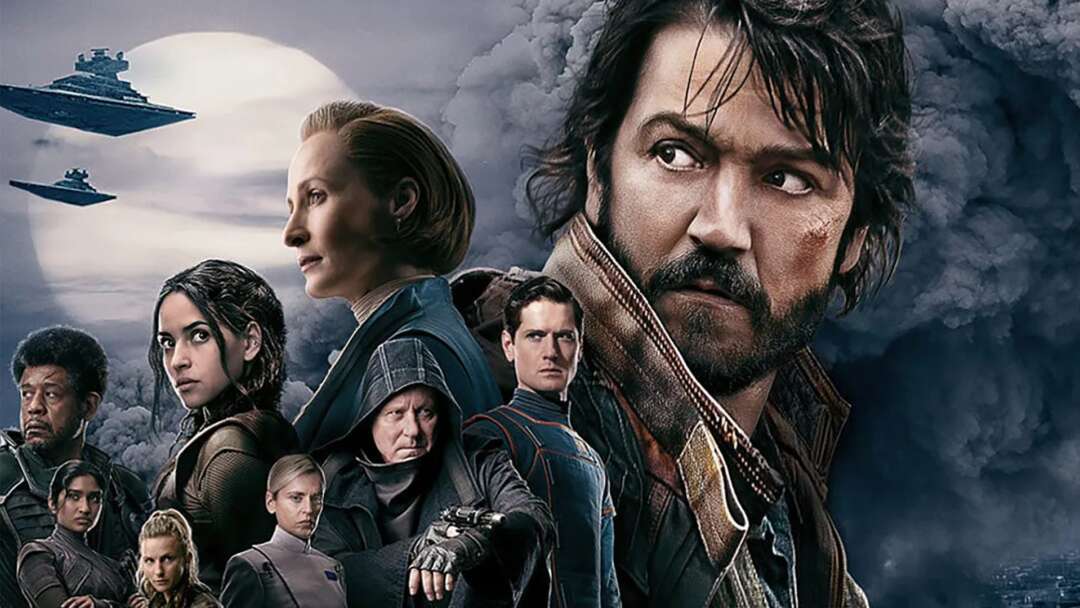
Andor has become the highest-rated Star Wars TV show to date with a Rotten Tomatoes score of 97% (Amaya). The second season of Andor has been particularly praised for its political literacy and representation of the Empire’s fascist regime. Andor depicts psychological torture, labour camps, imperial genocide, illegal searches, and the propaganda machine of the Empire over its two seasons, and by much praise and outcry, the franchise’s first sexual assault scene. As Walter Benjamin argues, “All efforts to aestheticize politics culminate in one point. That one point is war” (original italics; Benjamin 995). Consequently, Susan Sontag explains that the aesthetics of fascism are rooted in the spectacle of “domination and enslavement” that seek “control, submissive behaviour, and extravagant effort” (par. 33); fascist aesthetics rely on the glorification of surrender and inanity to allure “the massing of groups” (par. 33). The Empire is a fascist regime, whether fans accept this fact or not, and by missing the glaring aesthetics of fascism, fans become victims to these ideologies. For Disney’s Star Wars to engage in dialogues and portrayals of fascist politics as an opaque oligopoly is shocking, and more so in the context of Donald Trump’s America. Ultimately, Andor is a piece of popular culture that wrestles with the franchise’s neoliberal roots by depicting fascist practices. Through the similarities of depicting ICE raids and rape allegations, Andor explores fantasy as a reality. In an attempt to make a commentary on fascist America, whether intentional or not, Andor reinforces the urgency of such reflections to eliminate the gap of dissonance.
Imperial Officers as Targeted Enforcement
Star Wars has always been political. While the genre schema of Star Wars has been an amalgamation of space fantasy, western, and samurai styles, its political commentary on power structures has remained a through line—at least in the first six films. Much like culture, the Star Wars films are a product of the political moment in which they occur (Kempshall 25-26). Vaux et al. argue that the 1977 film, A New Hope, is a commentary on imperial America and the Vietnam War; similarly, the prequels (1999-2005) are a commentary on Richard Nixon and George W. Bush as authoritarian leaders. Within the film’s cultural sandbox, there are many connections to fascist regimes. In particular, the stormtrooper name and costume were directly pulled from Nazi Germany’s Sturmabteilung (Kempshall 29). The importance of analyzing Andor today is not solely its reflections on Trump’s America, but how Star Wars reinscribes its fascist inspirations onto Trump’s America. In the Star Wars canon, Andor takes place between five years to a few days before the events of A New Hope, and since Andor is situated so closely to the original, the show can more readily remap fascist aesthetics with modern politics. In its proximity to A New Hope in the Star Wars timeline, Andor has the immediacy and accessibility to A New Hope’s political inspiration and visual aesthetics more than its sequel era films, more effectively blurring the lines between Nazism and American authoritarianism.
Although there are many comparisons to America, the eerie similarities between the Empire’s unannounced inspections and America’s ICE raids cannot be overlooked. The story arc in the first three episodes of Andor season two illustrates what life is like under Imperial rule. Bix Caleen, Wilmon Paak, and Brasso work as undocumented farm workers on Mina-Rau, laying low after season one’s rebel counterattack. In episode three, “Harvest,” stormtroopers and Imperial officers arrive in military tanks with assault rifles to inspect visas and quotas, and when visas prove to be false these workers are either killed, raped, or imprisoned in labour camps (see Fig. 1). Within this context, these people are not just killed for being undocumented to make ends meet, they are also exploited through the permissible and legal form of labour: incarcerated labour. The language used by Imperials resembles reality with them “checking visas” of labourers (6:13). One Imperial officer declares that “It’s a tough spot for everyone. The councils need the help, or there’s no harvest. The help is undocumented. The rules are clear, but the situation requires… nuance” (emphasis add; “Harvest” 36:32-37:00). The sinister nature in which the officer says “nuance” after a brief pause, indicates the fascist undertone of “domination and enslavement” (Sontag par. 33). Indeed, domination and enslavement are illustrated through the antagonistic and doubly exploitative relationship between the Imperial regime’s need for cheap labour while criminalizing the undocumented workers that provide that labour. This cyclical exploitation is maintained through fear of visa checks and retribution; thus, illegality makes it easier for Imperials to hold control over their capitalist productions because these undocumented workers are denied rights. It becomes clear that the harvest is not truly the harvesting of agricultural products, but the ‘harvesting’ of undocumented workers.
Further, the Imperials have a frequency blockade over the Mina-Rau, isolating the planet and making it impossible to get outside help. Throughout, Kellen, the crop manager, communicates with Brasso and the other farm workers about when inspections will start in their sector. The basis of Kellen and Brasso’s relationship to each other, as well as the other workers, is one of care to protect the community of Mina-Rau from Imperial threat; Kellen is seen repeatedly telling Brasso about predicted inspection dates in order for Brasso to protect his family. This is especially important because not only are they rebels in hiding, but Brasso’s family is also racialized, thus considerably more at risk of being targeted by Imperials. Later in the episode, Wilmon says goodbye to his girlfriend, the daughter of Kellen, without telling the others, and Brasso leaves to find him. When Brasso arrives at the homestead he is caught by Imperials, and to protect the family, lies that Kellen sold him out: “You’re gonna pretend you didn’t tell ‘em [….] You betraying bastard! Use us up. Turn us in” (38:12-38:31). Rather than the crop manager exploiting labourers, it is the Empire who exploits its labourers, and Benjamin articulates this exchange: “Imperialist war is an uprising on the part of technology, which demands repayment in ‘human material’ for the natural material society has denied it” (original italics; Benjamin 996). By examining how Andor engages with America’s current political moment through digestible narratives, the world of Andor and our own reveal frightening similarities.
Trump was inaugurated for his second term on January 20th, 2025, while Andor season two finished filming in February of 2024 (Bespin Bulletin). Despite the almost full-year gap between these events, the parallels are uncanny. Trump and his regime’s ideology is grounded in white supremacy, nationalism, and spectacle, and what worries many is “the potential normalization of [a] Nazi state” (Gonzalez 70). In particular, Trump uses the rhetoric of nationalism to condemn the undocumented (15). For example, in a 2023 speech, Trump quoted from Mein Kampf that immigration “‘is poisoning the blood of our country’” (Gonzalez 15; Sainto par. 1). While Star Wars takes inspiration from fascist histories to make social commentaries, Trump does the same thing, but to inform and legitimize his policies and propaganda; paradoxically, the Trump era provides a contemporary framework through which Star Wars rearticulates authoritarian leadership for modern audience. Further, Trump uses ICE, or “his storm troopers” (O’Toole par. 11), as a spectacle empowered by racial profiling. ICE raids similarly ‘harvests’ and ‘reaps’ workers as many undocumented immigrants come to America to find jobs and better economic opportunities, not unlike Brasso, Wilmon and Bix. The parallels between the Empire’s inspections and ICE raids show that the physical violence enacted on undocumented immigrants is the same (see Fig. 2 and 3), and similarly, so is the ‘harvesting’ of workers. Overall, Andor pulls from fascist regimes of the past and the current political climate in America to generate its narrative material.
Rape as a Fascist Weapon
The most controversial event in Andor season two was the attempted rape scene, in which fascist policing is revealed to be what it is: repressive, fear-driven, and militaristic. In episode two, an Imperial officer questions Bix regarding her husband’s whereabouts while intently objectifying her (17:41-18:19). Then, in episode three, after Brasso goes out to find Wilmon, the Imperial officer with his tank arrives at her house, asking: “No sign of your husband?” (34:40). She is home alone. The Imperial officer knows she is ‘illegal’: “We’ve been counting visas” (36:35). The Imperial officer closes on her and says “I’m always looking for ways to relax… All that hard work, you must have strong hands” (37:13-37:30). While she is a woman of colour and undocumented, Bix is primarily targeted because of her gender, as Brenda Fitzpatrick notes that women are perceived as vulnerable and therefore more likely to be targeted by fascist regimes. It is unclear whether the officer will ignore Bix’s visa status if she performs fellatio, or if she will be detained anyways. Similar to Benjamin’s idea of “repayment in ‘human material’” as an imperialist aesthetic (996), Fitzpatrick identifies the weaponization of rape as “tactical rape,” which refers to:
“a tactic by state or non-state actors to attack individuals, groups and communities deemed to be enemies in conflicts [….] Tactical rape targets civilians, particularly, although not exclusively, women and girls. Gendered social, political, economic and physical inequity creates gendered vulnerability that is a pervasive precondition for effective use of tactical rape as a specific strategy to control.” (Fitzpatrick 5)
Bix is a victim of tactical rape. The Imperial officer has deemed her to be an enemy of the Empire, yet ironically, his intent to use Bix for human repayment overshadows her concealed identity as a rebel: the true enemy.
Further, the Imperial officer’s attempted tactical rape seeks to control and exploit Bix. To the officer, Bix has no power. She cannot ask for help from other Imperial officers or call for her family without risking their detention; moreover, she is a woman, a symbol of vulnerability to the officer. The scene continues with the Imperial officer cornering her, where she begs for him to stop, “I said, no!” (39:13) and bashes his nose with her hand. Bix tries to run away, and the officer throws her down, until Bix beats him multiple times with a wrench until he is dead (39:35-40:48). The scene ends with another Imperial officer hearing the screams and sees the officer’s dead body; the officer asks Bix to come out with her hands up and she exclaims that “He tried to rape me!” (41:57). The officer does not care, as Bix is still undocumented, and she shoots him (42:23). This is the first time that the word “rape” is said in the Star Wars universe and the first time that it is depicted so explicitly. There have been other inferences of sexual assault in Star Wars, like slave Leia and Jabba’s enormous tongue, but they are glossed over. The scene between Bix and the officer is a clear depiction of tactical rape and thereby an article of fascist control; the officer seeks to isolate Bix, so she is forced to comply and be made an example of to the community of what happens when “enemies in conflict” interrupt and resist imperial law (Fitzpatrick 5). This would instill fear in the community of Mina-Rau, resulting in, theoretically, docile workers. Rape, and the threat of rape, are tools of oppression for fascist regimes as it maintains compliance. To the Imperial officers, Bix is simply an undocumented farm worker who needs to be punished because she evades Imperial surveillance, but they are unaware that she is a rebel who can defend herself (Bacon par. 9). The power imbalance of Imperial officers/ICE agents and an undocumented Latina woman is stark and a reality many experience in America. The depiction of rape during the Empire’s reign is not simply used for shock value or spectacle, but accurately represents what fascist rule is like for women.
Since Trump’s second term and the subsequent rise in ICE detainees, it is no surprise that the number of women being sexually assaulted has also increased. There are two areas where these assaults are happening: in ICE detention centres and by those impersonating ICE agents. Between 2015-2021, over 300 sexual assaults in ICE detentions centres were reported by Futuro (Warsi par. 14). In a CNN report, two dozen filed incidents of ICE impersonators have been found since Trump’s second term, a 12 time increase since 2024 and the highest it has ever been (Gordon et al. par. 7). The rise of sexual assault and ICE impersonators are not separate issues, as the purpose behind impersonating an ICE agent is to sexually assault women. Undocumented people are “deemed to be enemies in conflicts” (Fitzpatrick 5), yet they become scapegoats, a spectacle to distract and enable the encroachment on the masses from American fascism. The fascist rhetoric of immigration and sexual assault as a fascist weapon is mirrored in Andor. While the Imperial officer is not impersonating per se, he does reproduce the many aspects of ICE-related sexual assault reports. He uses his position of power as a method of intimidation and fear to coerce Bix into submission. This power imbalance is evident through ICE-related sexual assaults, but also in Andor. In these contexts, undocumented workers are in a position to comply and remain silent because they have no legal authority or power to report the assault. This is how rape functions as a weapon of fascism: authority figures use tactical rape as a tool to coerce consent and silence victims; in conjunction, the threat of tactical rape suppresses dissent in favour of productive labourers seeking to avoid imperial attention. As a result, Bix and others like her are cast as scapegoats, not because they were targeted by imperialist leadership, but because they were ‘illegal,’ an ‘enemy’ to the Empire, and ‘needed to be punished.’ Andor’s sexual assault scene exposes that acts of sexual violence are much more prevalent in a galaxy far, far away than audiences care to admit. Ultimately, the echoes of fascist America are evident through Andor’s depiction of weaponized and tactical rape.
Fan Reactions: Make Star Wars Great Again
The parallels between Andor and America are important to compare, but apart from plot similarities, the fan reactions to these fascist aesthetics are numerous. In the responses to the rape scene, the media has split into two groups: (1) supporting the authentic representation of fascism, and (2) Star Wars has gone too far. Such headlines in support of Andor’s advocacy are The Mary Sue’s, “So you can accept genocide in ‘Star Wars’ but not what happened to Bix Caleen?” (Leishman) and Ms. Magazine’s, “Rebellions Are Built on Hope’: How ‘Andor’ Carved a New Path for Exploring Authoritarianism, Sexual Violence and Resistance” (Ross). These headlines articulate the political message of Andor, the overt fascist and authoritarian aesthetics of the show, and its real-world applications. Their counterparts, however, point to fans threatening “to ‘stop watching’ as Star Wars spin-off takes ‘disgusting’ turn” from the Daily Express (Hill-Paul) and “Was Andor right to make sexual assault part of the Star Wars canon?” from the London Evening Standard (Block). Dork Side of the Force suggested that “Andor’s ‘Harvest’ needed a content warning” (Mullinax). The only content warnings for the episode were “TV-14” and “Strong coarse language, Intense violence” (0:19), which is not different from any other episode of Andor. These headlines are not pro-fascist by any means, yet they suggest a lack of coherency that connects rape to fascism. These titles sensationalize and oversimplify the purpose of tactical rape in Andor, and as George Gonzalez states, there is a difference “between propaganda (art that is political) and political art (art that imparts important, critical ideas about hegemonic groups as well as their values, politics)” (Gonzalez 4). Rape discourse participates in political art because it accurately represents the gendered experience of (fascist) violence, as most of Star Wars does not; traditionally, Star Wars has depicted the male experience of war with patriarchal lineage, warriors, and defending freedom, while female figures remain the love interest. Thus, the uproar from fans insinuates that the gendered experience of violence is trivial.
Apart from op-ed journalism, fans of Star Wars are making their opinions known on social media platforms. One Reddit thread titled, “(LES) The fandom reaction to THAT scene from Andor Season 2 is hilarious,” critiques fan responses that completely reject the idea of depicting rape in Star Wars. Some comments express disbelief that audiences are more readily to “stomach blowing up a planet and killing billions” than depictions of sexual violence; while others use humour to remark, “What? You’re telling me the Empire abuses its power? What a startling revelation that we surely didn’t learn (checks notes) almost half a fucking century ago” (original italics; see Fig. 4). These Reddit commenters are referring to YouTube personalities like StarWarsTheory and ThatStarWarsGirl. StarWarsTheory is known in the Star Wars community for his outwardly neomasculine views on the franchise. The day after the first three episodes of Andor were released, he posted on X that “SA in [Star Wars] feels unnecessary. You can portray power dynamics and making the audience hate the empire in other ways without taking it to such a disgusting place. Vader wouldn’t tolerate that shit nor does the Empire condone it. It has no place in Star Wars. Period. Unnecessary” (@realswtheory). As I have stated earlier, it is significant that Andor portrays fascist aesthetics of tactical rape; the Star Wars fanbase is comprised of a male majority, and to have audiences ingest this type of content, which has so far been excluded from Disney’s and the Empire’s franchise, is entirely the point. StarWarsTheory’s comment indicates that these male fans perceive Bix’s sexual assault as a ‘random event,’ that would not be ‘condoned’ by the Empire, rather than as a direct result of fascist persecution enabling this assault. The inability of so many to see sexual abuse, whether or not it is explicitly ‘condoned,’ as a result of authoritarian oppression is incredibly significant. Also, setting the ethical line at Darth Vader for morals is ill-founded, as Vader is the pinnacle of evil and glorifies murder, as well as choking his pregnant wife. Yet this is the cognitive dissonance of knowing that rape is a weapon of war, while not wanting to accept the politically inspired canon of Star Wars.
ThatStarWarsGirl also posted a similar sentiment on X: “Watched Andor season 2 & yep it’s real. An imperial officer tries to grape [sic] Bix. Using the power dynamic that she’s illegal & he can deport her. It’s beyond fucking retarded [sic] & doesn’t belong in Star Wars”(@thatstarwarsgrl). Again, presenting imperial legacies alongside the ‘untouchable’ legacy of Star Wars emphasizes the cognitive dissonance of the fanbase. Further, fans are not just denying the representation of rape, but also the ‘anti-ICE’ comparisons. One Threads user commented that Andor “was not ‘pro-immigrant’. It told a story involving fugitives from another planet. Stop the projecting and just watch the story,” while the next commenter replied “Lmao, they were undocumented immigrants, there was an entire conversation about how the empire knew they needed the workers but also knew they didn’t have legal status, and at that moment they had no idea these people were wanted fugitives. It was solely about immigration then and there.” (see Fig. 5). At least this example, while showcasing the cognitive dissonance of fans, also shows fans calling out dissonance. So, what does belong in Star Wars? And who gets to mandate these inclusions?
Star Wars fans have a sense of inheritance when it comes to their fandom. The production of these generational franchises (e.g. Star Trek, Marvel, DC) risks reinforcing “hegemonic masculinity, whiteness, and heteronormativity” in the culture industry, resulting in “a battleground to defend those inheritances from forces that would now ruin them” (Johnson 86-87). These forces are feminism, queerness, and racial diversities that disrupt white supremacy and neomasculinities (90). This is what Derek Johnson describes as franchises’ “potential force of both victimization […] and masculine revitalization” (90). This is the cultural battleground for maintaining the status quo while offering new stories that Andor falls into: (1) Fans want new stories, (2) but not too different from the original material or ideologies, (3) and that have nostalgia but do not rely on said nostalgia. As Abigail Reed claims, “Star wars is part of our popular mythos” (4), and changing the equilibrium of the franchise in any way results in dislocating the fanbase. In previous Star Wars projects, there have been coded discussions on slavery (The Phantom Menace), parallels to Nazi Germany (The Force Awakens), and dictators (basically every Star Wars movie), but the explicit portrayal of current immigration and rape politics is too political.
Disney for Profit
Disney, which purchased Lucasfilm in 2012 for 4 billion dollars, is an intrinsically capitalist entity. The tension between Star Wars’s roots in political commentary and Disney’s neoliberal media regime is described by Reed as: “The politics that are supported in Star Wars must [also] support the corporate logic that allows Disney to remain a repressive global superpower” (Reed 117). Due to Disney’s “political economic power” (4), the company’s Star Wars sequel trilogy lost its political edge because neoliberalism reinforces the inescapability of systemic structures—like capitalism and white supremacy—to maintain the status quo (Reed 82; Horkheimer and Adorno 1041). Consequently, the discourse of immigration and sexual violence in Andor disrupts Disney’s political economic power by casting a diverse cast in a predominantly white canon and writing a story with real-world fascist politics. Amidst the attachment to the white, masculine, heteronormativity of the franchise, a comfortable idea of what evil is emerges: distant ideas of space warfare and evil emperors. The reactions from StarWarsTheory and ThatStarWarsGirl create a misconception of evil as they refuse to understand how something like the Empire could exist in real life. While the show operates in capitalist frameworks, Andor still manages to capture the current political moment in the West under the conglomerate of Disney. This opposes Max Horkheimer and Theodor Adorno’s concept of the culture industry as mere entertainment (1036). Yet they also claim that art works to create truth through imitating life, and that is exactly what Andor has done (1038).
Closing Comments
Star Wars and Andor are inherently political, whether fans want to reject this fact or not. While Andor grapples with the fascist realities in America and opposes Disney’s neoliberal ideologies, it is a piece of popular culture that safely explores these realities in a genre that seems distant. Andor lulls fans into thinking they are watching the next installment of their beloved space opera, yet real-world politics are wrapped inside as a covert mission to provide conscious political thought.In addition, the parallels to Trump’s America speak to the dangers of glorifying fascism for spectacle. Through Andor’s political commentary, the gaps in cognitive dissonance in fan reactions and the divisive media are revealed to be what they are: denial. Fans must confront the ugly side of their fandom: the racist caricatures in The Phantom Menace to the deep-rooted fascist aesthetics of the Empire must be understood as the franchise’s legacy, as well as the importance of dismantling these legacies in new iterations of Star Wars. The dismissal of popular culture as entertainment is wrong and needs to be understood for its resistive power to hegemonic ideologies of sameness. Ultimately, a galaxy far, far away is nearer than we want to admit.
Appendix
Figure 1. Screen capture of Imperial troops on a tank; Andor; season 2, episode 3; Tony Gilroy; 22 Apr. 2025; 43:26.
Figure 2. Screen capture of Imperial troops detaining Brasso; Andor; season 2, episode 3; Tony Gilroy; 22 Apr. 2025; 38:00.
Figure 3. Screen capture of ICE agents detaining a man; Hyoung Chang/Getty Images; ABC News; 5 Feb. 2025; https://abcnews.go.com/US/ice–agents–door–door–coloradoresidents–edge–reporters/story?id=118527489; Accessed 13 Dec. 2025.
Figure 4. Screen capture of Reddit thread “(LES) The fandom reaction to THAT scene from Andor Season 2 is hilarious,” with posts about the morality of rape and murder; Reddit; https://www.reddit.com/r/CharacterRant/comments/1k91yk4/les_the_fandom_reactio n_to_that_scene_from_andor.com; Accessed 13 Dec. 2025.
Figure 5. Screen capture of Threads posts about whether or not Andor is pro-immigration; Threads; https://www.threads.com/@urquwill/post/DJwdYQiNRV9/for–all–the–crappeople–gave–the–acolyte–for–having–a–woke–agenda–andor–came–and?hl=en; Accessed 13 Dec. 2025.
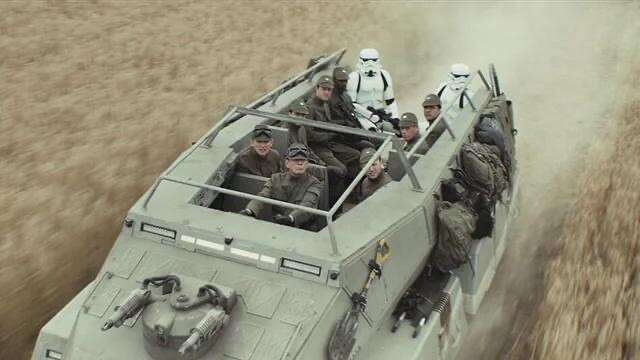
Figure 1
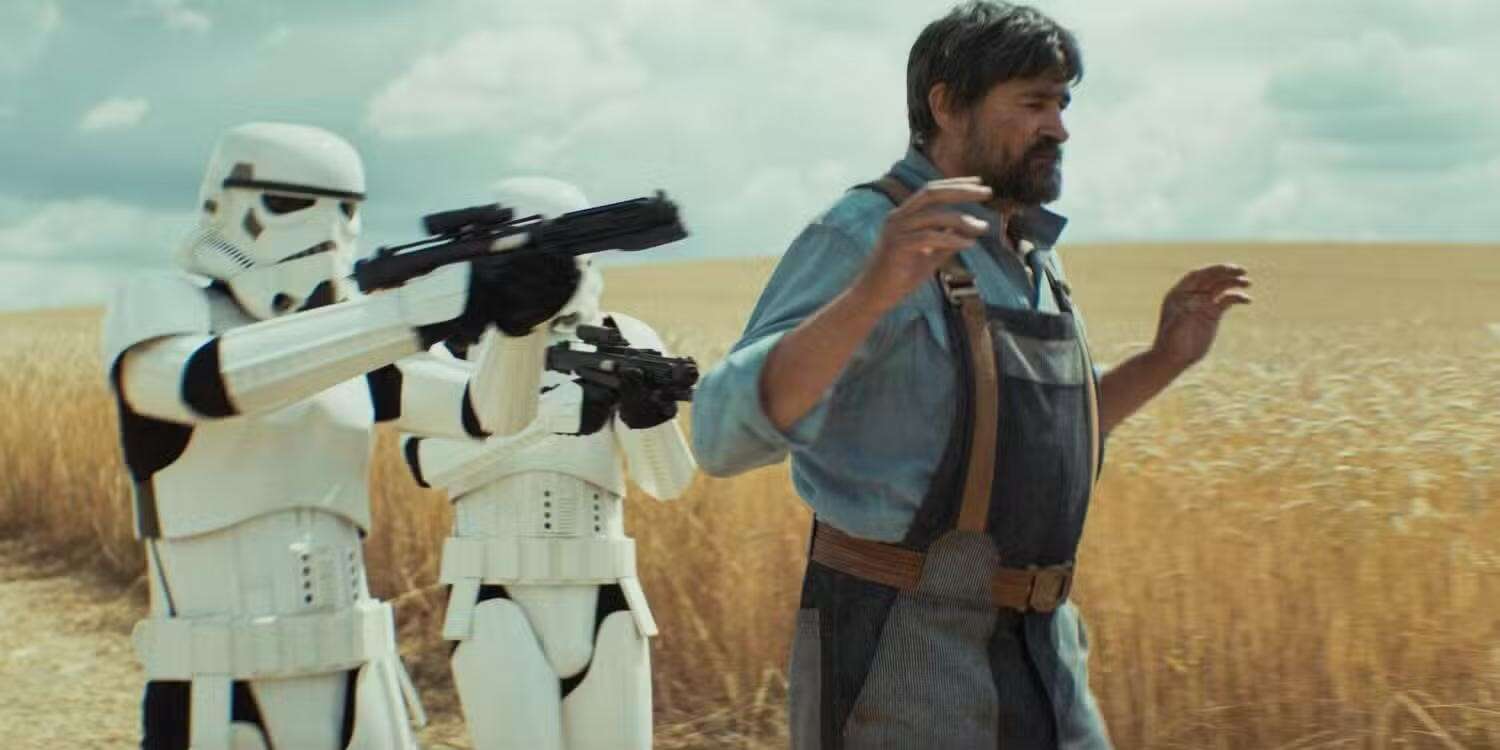
Figure 2

Figure 3
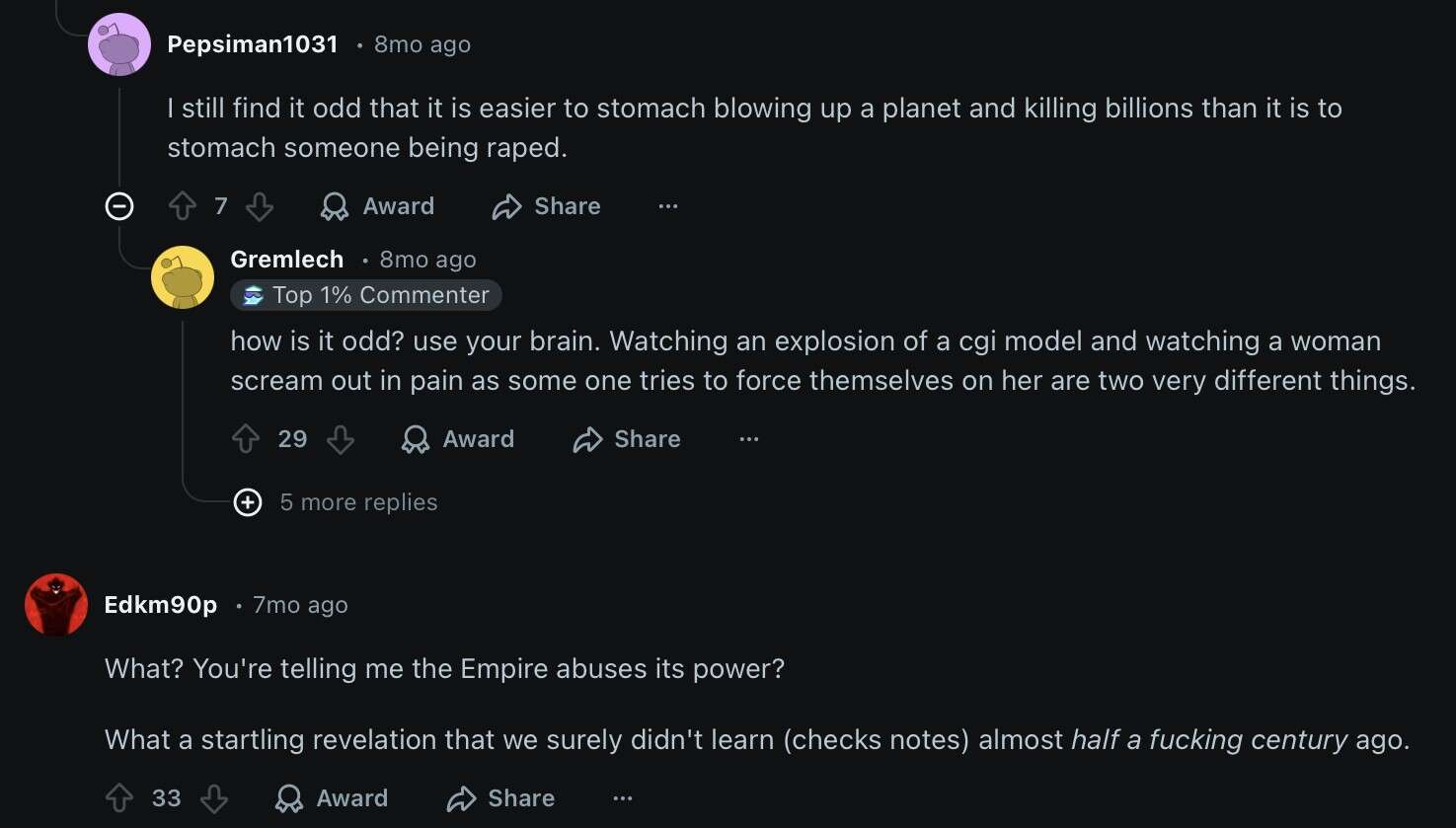
Figure 4
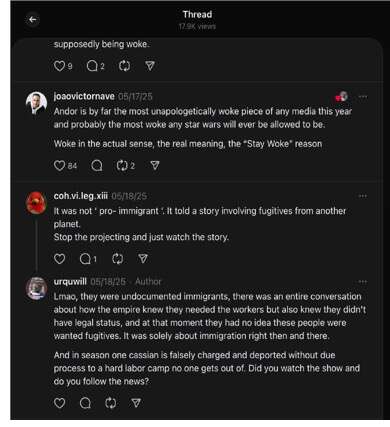
Figure 5
Works Cited
Adams, J.J. Star Wars: The Force Awakens. 2015.
Amaya, Erik. “Star Wars TV Shows Ranked by Tomatometer.” Rotten Tomatoes Star Wars TV Shows Ranked by Tomatometer Comments, Rotten Tomatoes, 13 May 2025, editorial.rottentomatoes.com/guide/star–wars–tv–ranked/. Accessed 13 Dec. 2025.
Bacon, Thomas. “Andor Season 2’s Most Brutal Scene Just Exposed A Dark Secret About the Star Wars Fandom.” ScreenRant, Screen Rant, 23 Apr. 2025, screenrant.com/andor-season-2-star-wars-fandom-dark-secret/. Accessed 13 Dec. 2025.
Benjamin, Walter. “The Work of Art in the Age of Its Technological Reproducibility.” Norton Anthology of Theory and Criticism, vol. 3, W. W. Norton & Company, Inc., 2018, pp. 976–996.
Bespin Bulletin. “Star Wars: Andor Season 2 has finished filming.” Bespin Bulletin, 9 Feb. 2024, bespinbulletin.com/2024/02/star-wars-andor-season-2-has-finished-filming/. Accessed 13 Dec. 2025.
Block, India. “Was Andor right to make sexual assault part of the Star Wars Canon?” The Standard, Evening Standard, 25 Apr. 2025, www.standard.co.uk/culture/tvfilm/andorseason–2–star–wars–bix–rape–sexual–assault–b1224298.html. Accessed 13 Dec. 2025.
Fitzpatrick, Brenda. “Introduction.” Tactical Rape in War and Conflict: International Recognition and Response. Bristol University Press, 2016, pp. 1–26.
Gonzalez, George. The Anti-Enlightenment in Popular Culture: Greed, Hate, Star Wars, and Star Trek, Peter Land Publishing Inc., 2024.
Gilroy, Tony, writer. “Sagrona Teema.” Andor, season 2, episode 2, Lucasfilm, 22 Apr. 2025. Disney+.
Gilroy, Tony, writer. “Harvest.” Andor, season 2, episode 3, Lucasfilm, 22 Apr. 2025. Disney+.
Gordon, Allison, et al. “Ice Impersonator Incidents Rise during Trump’s Second Term.” CNN, Cable News Network, 2 Oct. 2025, www.cnn.com/2025/10/02/us/iceimpersonator–incidents–rise–invs–vis. Accessed 13 Dec. 2025.
Hill-Paul, Lucas. “Andor fans threaten to ‘stop watching’ as Star Wars spin-off takes ‘disgusting’ turn.” Express.Co.Uk, Express.co.uk, 23 Apr. 2025, www.express.co.uk/showbiz/tv-radio/2045276/andor-season-2-bix-rape-star-wars. Accessed 13 Dec. 2025.
Horkheimer, Max, and Theodor W. Adorno. “Dialectic of Enlightenment.” Norton Anthology of Theory and Criticism, vol. 3, W. W. Norton & Company, Inc., 2018, pp. 1033– 1050.
Johnson, Derek. “From the Ruins: Neomasculinity, Media Franchising, and Struggles over Industrial Reproduction of Culture.” Communication, Culture and Critique, vol. 11, no. 1, 2018, pp. 85–99, https://doi.org/10.1093/ccc/tcx013.
Kempshall, Chris. The History and Politics of Star Wars: Death Stars and Democracy. 1st ed., Routledge, 2023.
Leishman, Rachel. “So you can accept genocide in ‘Star Wars’ but not what happened to Bix Caleen?” The Mary Sue, 23 Apr. 2025, www.themarysue.com/so–you–can–acceptgenocide–in–star–wars–but–not–what–happened–to–bix–caleen/. Accessed 13 Dec. 2025.
Lucas, George. Star Wars: A New Hope. 1977.
Lucas, George. Star Wars: The Phantom Menace. 1999.
Mullinax, Hope. “Andor’s ‘Harvest’ needed a content warning.” Dork Side of the Force, Dork Side of the Force, 24 Apr. 2025, dorksideoftheforce.com/star–wars–andorharvest–needed–content–warning. Accessed 13 Dec. 2025.
O’Toole, Fintan. “A Show of Force.” The New York Review, July 1, 2025, https://www.nybooks.com/articles/2025/07/24/a-show-of-force-fintan- otoole/. Accessed 13 Dec. 2025.
@realswtheory. “SA in SW feels unnecessary. You can portray power dynamics and making the audience hate the empire in other ways without taking it to such a disgusting place. Vader wouldn’t tolerate that shit nor does the Empire condone it. It has no place in Star Wars. Period. Unnecessary.” X [public account], 23 Apr. 2025, 12:17am, https://x.com/realswtheory/status/1914896363051212849?ref_src=twsrc%5Etfw%7Ct wcamp%5Etweetembed%7Ctwterm%5E1914896363051212849%7Ctwgr%5E99207 d556d530726c1fa894322cd2e547563095a%7Ctwcon%5Es1_&ref_url=https%3A%2 F%2Fwww.businessinsider.com%2Fandor-sexual-assault-scene-star-wars-adriaarjona-character-2025-4. Accessed 13 Dec. 2025.
Reed, Abigail. Neoliberal Aesthetics of Resistance in the Disney Star Wars Films:
Rescripting Rebellion, Lexington Books, 2024.
Ross, Cat. “‘Rebellions Are Built on Hope’: How ‘Andor’ Carved a New Path for Exploring Authoritarianism, Sexual Violence and Resistance.” Ms. Magazine, 15 Sept. 2025, msmagazine.com/2025/05/29/andor–review–feminist–rape–authoritarianism–resistancerebellion/. Accessed 13 Dec. 2025.
Sainato, Michael. “A third of Americans agree with Trump that immigrants ‘poison the blood’ of US.” The Guardian, Guardian News and Media, 18 Oct. 2024, www.theguardian.com/us-news/2024/oct/18/election-trump-immigration-poll. Accessed 13 Dec. 2025.
Sontag, Susan. “Fascinating Fascism.” The New York Review of Books, The New York Review, 6 February 1975, www.nybooks.com/articles/1975/02/06/fascinatingfascism/. Accessed 13 Dec. 2025.
@thatstarwarsgrl. “Watched Andor season 2 & yep it’s real. An imperial officer tries to grape Bix. Using the power dynamic that she’s illegal & he can deport her. It’s beyond fucking retarded & doesn’t belong in Star Wars.” X [public account], 24 Apr. 2025, 5:05pm, https://x.com/thatstarwarsgrl/status/1915512438856044562.
Vaux, Robert, et al. “How a Real-Life War Inspired George Lucas’ Star Wars Vision.” CBR, 17 May 2025, www.cbr.com/george-lucas-vietnam-war-star-wars-inspiration/. Accessed 13 Dec. 2025.
Warsi, Zeba. “Hundreds of immigrants have reported sexual abuse at ICE facilities. Most cases aren’t investigated.” PBS, Public Broadcasting Service, 21 July 2023, www.pbs.org/newshour/nation/hundreds–of–immigrants–have–reported–sexual–abuseat–ice–facilities–most–cases–arent–investigated. Accessed 13 Dec. 2025.
Read more at Sophia Shelley.
Articles, Public Pedagogy, ResistanceRelated News
News Listing
Aliana Nezova ➚
Unknowing Victims and Lost Futures: The Neoliberal War on Play and Children
Articles, Public Education, Public Pedagogy
Alicia Petrie ➚
Incel Capitalism: Weaponized Loneliness in a Neoliberal Patriarchy
Articles, Cultural Pedagogy, Resistance
Gavin Minard ➚
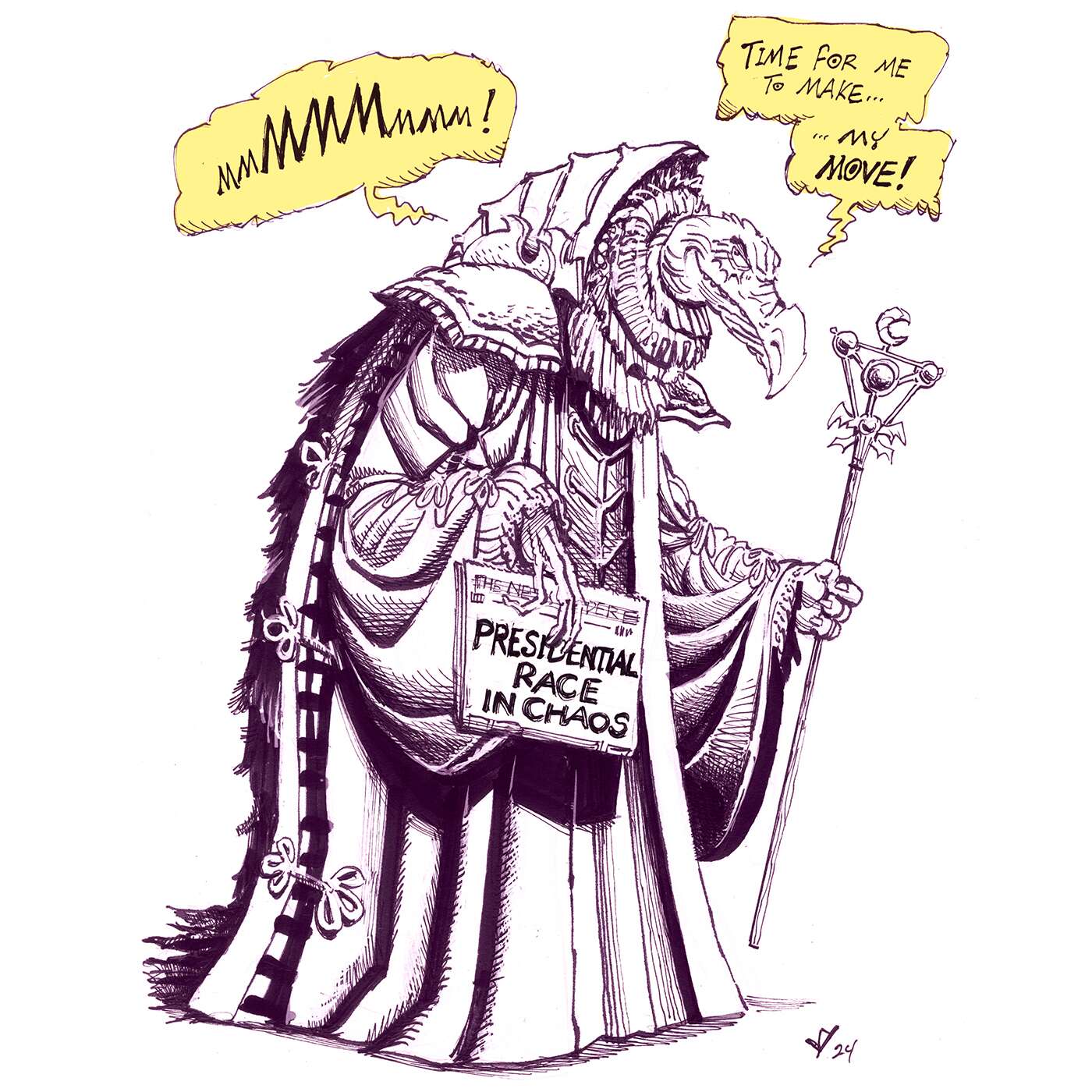
Truth to Power: ‘The Dark Crystal’ and the Fight Against the Disimagination Machine
Articles, Public Education, Resistance